
Tech Focus: Thrusters Aid the Advance of Autonomous Nav Systems
![Photo of MT Andaman, [IMO number 9807968] a 30m Indian Navy tug. Converted in 2024 for full uncrewed, remote piloting operation approved by the Indian Register of Shipping.
Image courtesy MDL.](https://images.marinelink.com/images/maritime/w80h50pad/photo-andaman-170467.jpg)


![Photo of MT Andaman, [IMO number 9807968] a 30m Indian Navy tug. Converted in 2024 for full uncrewed, remote piloting operation approved by the Indian Register of Shipping.
Image courtesy MDL.](https://images.marinelink.com/images/maritime/w800h500/photo-andaman-170467.jpg) Photo of MT Andaman, [IMO number 9807968] a 30m Indian Navy tug. Converted in 2024 for full uncrewed, remote piloting operation approved by the Indian Register of Shipping.
Image courtesy MDL.
Photo of MT Andaman, [IMO number 9807968] a 30m Indian Navy tug. Converted in 2024 for full uncrewed, remote piloting operation approved by the Indian Register of Shipping.
Image courtesy MDL.
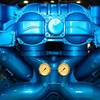
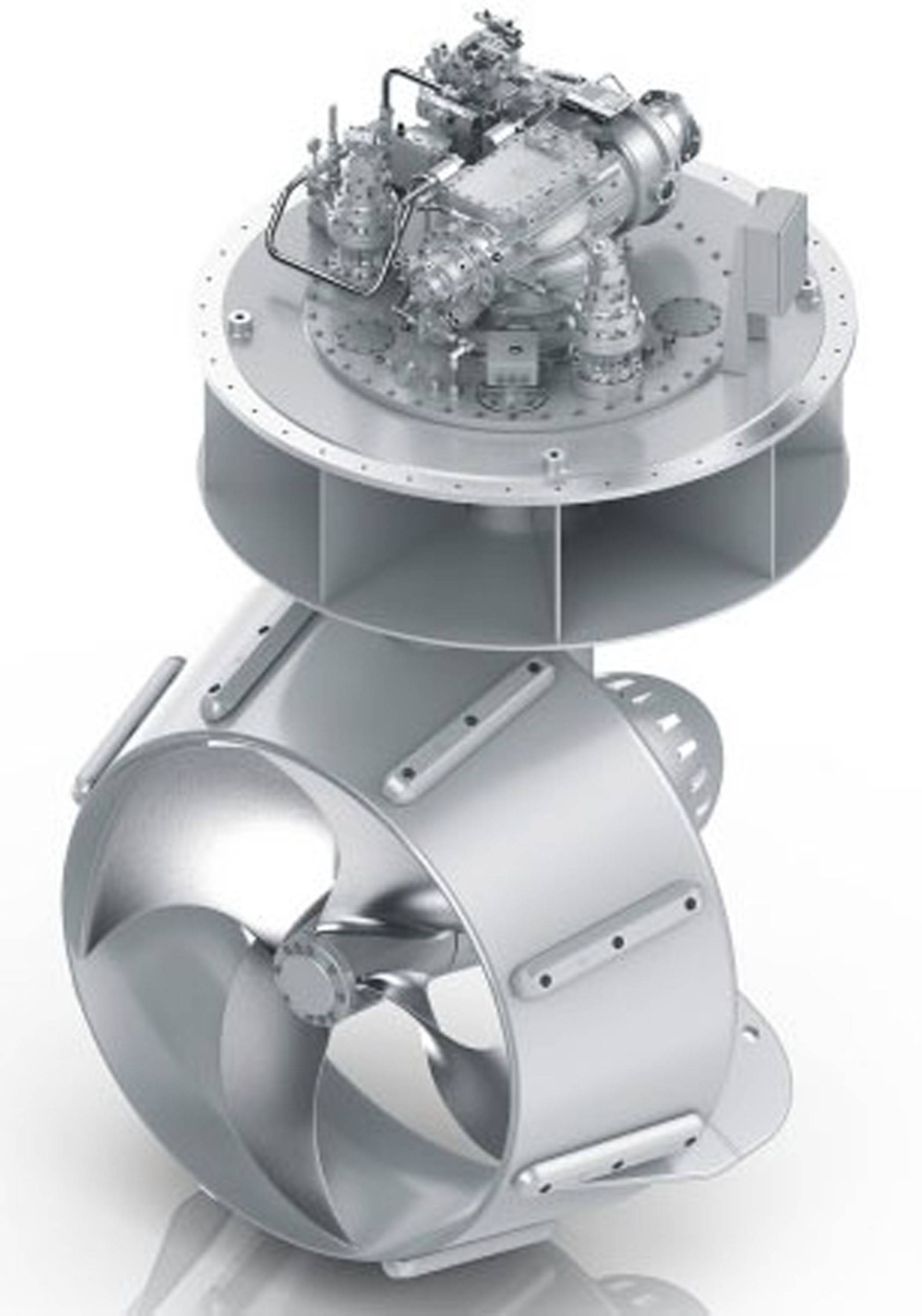
 An example of an azimuth thruster, a ZF AT50 rated at 815kW.
Image courtesy of ZF Marine.
An example of an azimuth thruster, a ZF AT50 rated at 815kW.
Image courtesy of ZF Marine.
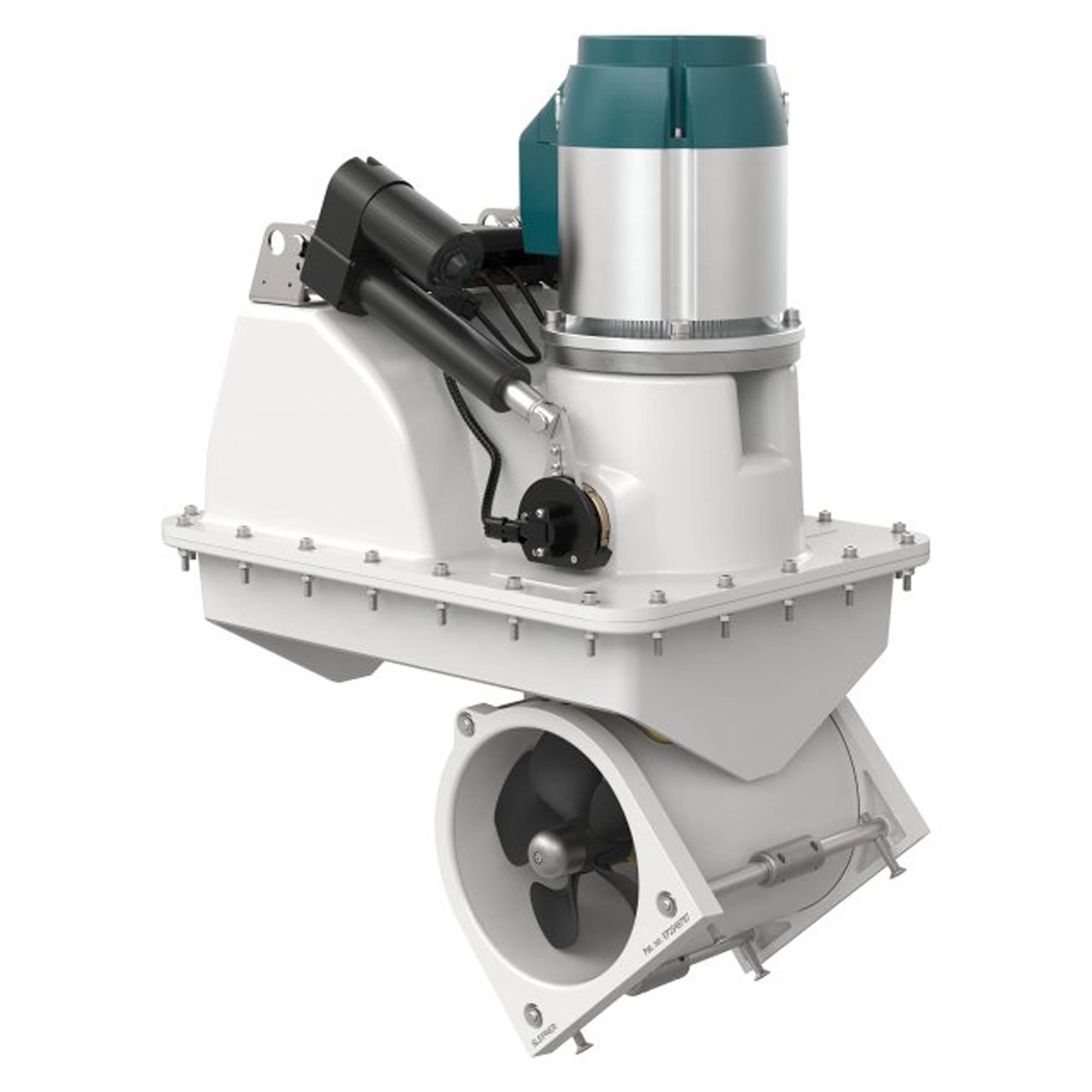
 An example of a 24VDC Sleipner ERV130 retractable thruster.
Image courtesy of Sleipner AS
An example of a 24VDC Sleipner ERV130 retractable thruster.
Image courtesy of Sleipner AS
![Photo of MT Andaman, [IMO number 9807968] a 30m Indian Navy tug. Converted in 2024 for full uncrewed, remote piloting operation approved by the Indian Register of Shipping.
Image courtesy MDL.](https://images.marinelink.com/images/maritime/photo-andaman-170467.jpg)
The demand for “thrusters” on recreational and commercial vessels has increased rapidly in recent years, providing vessels with enhanced capabilities.
Increasing a vessel’s manoeuvrability, making its steering more precise, to accurately control course and position offers greater versatility. New markets are opening to take advantage of new horizons with commercial opportunities.
Thruster operation may be manual by the helmsman or part of a Propulsion Management System (PMS). If integrated with an autopilot, its operation relieves the constant hands-on duty for one crew member. Going one step further, using an Autonomous Navigation System (ANS) such as Robosys VOYAGER AI, provides a constant situation awareness monitoring and by merging input from multiple sensors every second to evaluate approaching fixed or moving hazards.
The system’s own intelligence allows appropriate control of the vessel’s propulsion system, thrusters and steering to be applied to create the required COLREGS compliant vessel movements, without human intervention. An optional module can force the system to automatically take command to steer a path that avoids a collision.
A similar alternative system allows the vessel to be piloted remotely under radio or satellite control, with the ANS ensuring safe passage/return to base even if the remote control communications link is lost.
There are many different types of thrusters on the market, each one with specific attributes for each application, be it for a newbuild or a vessel already in service.
The purpose of the thruster determines the characteristics of the driving motor, be it mechanical, electrical or hydraulic. If it is required for propulsion, moving the vessel from A to B, then the ability to vary the speed is important, while for simple manoeuvring an on/off thruster motor may be adequate. For more precise manoeuvring to maintain station or position, exact control of speed is fundamental, which dictates the motor type and rating expressed in hours rather than minutes.
 An example of a single rim-type thruster for bow or stern mounting in a tunnel.
Image courtesy Rim Drive Technology
- Tunnel Thrusters, are installed within the hull transversely in the bow or stern, singly or in parallel as a pair. A single impeller is more common, but there are designs with two impellers providing greater thrust and also run quieter by reducing cavitation. Some models use a rim drive type of impeller.•Azimuth Thrusters allow full 360-degree rotation of the propeller generating thrust in any horizontal direction, thereby eliminating the need for a rudder. Installed singly or in multiples, they are more commonly used for propulsion rather than manoeuvring. ANS are able to control multiple thruster arrangements in a wide variety of sizes, larger units can propel workboats, tugs, right up to large cruise ships. A special variation, instead of the usual fixed installation, is the portable version comprising propeller, with or without a nozzle, drive shaft and engine. The unit is self-contained and permits self-propulsion of a barge for example. The engine, fuel tank and transmission are all part of the propulsion package, which may also be remotely controlled and operate with an ANS.
- Retractable Thrusters that remain protected within the hull yet can be deployed when required, providing additional manoeuvrability.
- Pumpjets are a special variety of waterjet thrusters mounted within the hull, are used for propulsion, with their thrust being vectored as required. Their impellers are enclosed and remain protected while vectoring thrust to allow the vessel to manoeuvre in any direction.
A major use of thrusters is for station keeping or dynamic positioning (DP), which controls both heading and position automatically. Dynamic Positioning (DP) is categorised by the IMO into DP1, DP2, and DP3 and prescribes exactly the accuracy, tolerance and reliability of the system. Simplified, non-redundant systems go under the description of station- or position-keeping.
Station keeping systems use a variety of sensors such as GPS, wind speed and direction, and IMU (Inertial Measurement Units). Greater accuracy and reliability can be increased by adding further sensors and positioning them in different locations. Dynamic sensor fusion, provides input to the PMS computer which disseminates the data into separate commands to the individual propulsion system and thrusters to maintain the vessel’s position, within prescribed limits.
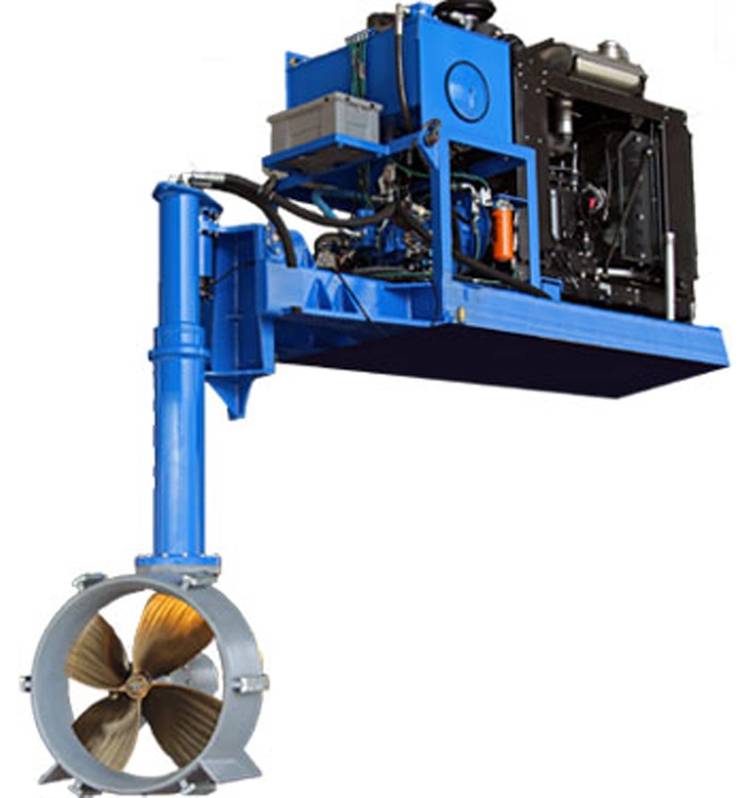 A portable azimuth thruster for barge or pontoon propulsion.
Image courtesy Thrustmasters of TexasCommercial Considerations
For all but a few special circumstances, the use of tugs in congested waters, decreased as vessels equipped with thrusters became able to manoeuvre alone. This reduces operating costs and opens up areas and waterways that were previously no-go areas. Improved positional accuracy and automated procedures help low crewed and uncrewed vessels carry out movements that would otherwise be difficult or dangerous.
In hydrographical survey markets, specially designed remote piloted unmanned vessels are replacing traditional manned survey vessels, thereby allowing surveyors and crew to be brought ashore. The elimination of onboard accommodation allows the unmanned vessels to be much smaller, and with the option of operating 24/7, with full control being exercised from shore stations. In some instances, control stations switch between two or more countries according to shift requirements while maintaining continuous control.
Movements of vessels on inland waterways are looking ahead for solutions to the future crewing shortages of these vessels, as recruitment to these industries face decline. A convoy system where one captain controls several vessels remotely is only possible with full control of the vessels’ movements enabled by thrusters. Some applications use radio controlled azimuth bow thrusters mounted in the lead vessel but controlled from the bridge of a pusher tug. Different parts of the world have different minimum crewing regulations relating to crew numbers based on ship size; in some cases, tug-barge combinations can reduce crew numbers as much as halve crew numbers.
The number of tugs able to be remotely controlled continues to increase, allowing lower manning levels with the captain controlling navigation remotely either ashore or from another vessel, yet with crew remaining onboard to handle the towing procedures.
Harnessing these new opportunities is the ability to add autonomous features to the navigation and power management of a single vessel or fleets of vessels. Automatically maintaining position saves crew hours and reduces fuel consumption. Repetitive tasks can be delegated to an autopilot with autonomous capabilities able to include thruster control when required. Growth in the fleets servicing the offshore windfarm industry is particularly appreciative of thruster equipped vessels where precise movement and station keeping play an essential part of the regular work tasks.
 An example of the special Schottel Pumpjet.
Image courtesy of Schottel GmbHWhile crewed operations of vessels is obligatory in many operations, there are application that fall into the categories of dull, dirty or dangerous. Perhaps an example of dull operation might be single and double ended ferries plying back and forth between stations. Their essential use of thrusters to aid safe and accurate positioning in most weather conditions greatly assists in maintaining a reliable ferry service.
The use of thruster equipped vessels on city canals to collect garbage from waterside locations as well as clearing up floating rubbish and debris, could fall under the term of dirty applications.
Many military and rescue services are regularly operating in potentially dangerous situations. Robosys recently participated in a US Army exercise with bridge-building vessels, equipping a VOYAGER AI system with full shore remote control to remove all crew from the vessel.
In a different but also dangerous duty, fighting ship fires faces the double danger of the survival of the vessel, and burning cargoes can produce toxic fumes. Being able to manoeuvre a remote controlled uncrewed fire boat or tug with FiFi1-class firefighting systems close-in without endangering crew members enhances its capabilities. The use of thrusters enables accurate positioning of the fire fighting vessel in relation to the burning ship and ensures its position is maintained to counter the thrust of the fire hoses. In 2024 Robosys successfully converted, a 30m Indian Navy tug, equipped with twin ZF azimuth thrusters for full unscrewed, remote piloting operation with full classification approval of the Indian Register of Shipping.
Although not essential for all operations, the addition of thrusters to a vessel’s equipment makes docking simpler, regardless of where the command is onboard or remote. In some cases by adding proximity sensors, docking can be automated.
The combination of thrusters and Autonomous Navigation Systems offers improved vessel control contributing to a safer working environment. Reducing crew levels in many applications will continue, while the use of system improvements will ensure increased safety in this market.
 About the Author: Keith Henderson is a Director of Robosys Automation Ltd. Since the 1990’s, he has been a contributor to Maritime Reporter magazine and Maritime Propulsion e-publication, published by New Wave Media. His articles have covered propulsion reliability, autonomous vessels, and the interaction between navigation systems and propulsion